Brisbane signage approval is the permission a business may need from Brisbane City Council before it puts up a sign. Some signs need it and some do not. The answer depends on the type of sign, its size, where it goes and whether the building is heritage listed.
Getting it wrong costs money. A sign built before the rules are checked can end up redesigned, moved or taken down. This guide explains how Brisbane signage approval works, what is usually allowed without an application, and what to sort out before you order.
SignArt QLD is a commercial signage company at 233 Leitchs Road, Brendale. We design, manufacture and install signs for businesses across Brisbane and South East Queensland. We are not the Council, and this is general information only, so confirm your own situation with Brisbane City Council.
What Is Brisbane Signage Approval?
Brisbane signage approval is Brisbane City Council’s process for assessing advertising devices, which is the Council’s term for signs. Some devices can be displayed without applying if they meet the Council’s Permitted Advertising Devices Designation. Others need approval first, and a few, such as bunting, fly posters and inflatable signs, cannot be approved at all.
In practice, “advertising device” covers more than a big sign on a building. It includes awning fascia signs, A-frames, commercial flags and information signs. The Council sorts them into groups. Some are self-assessable, meaning you can display them if you meet the listed limits. Others go through a standard assessment.
Which Business Signs Usually Do Not Need an Application?
According to Brisbane City Council, self-assessable devices can be displayed without applying for approval as long as they meet the Permitted Advertising Devices Designation. The Council lists several types that can fall into this group:
- Small business signs in business areas. This excludes Queen Street Mall, Valley Malls and any property with a Heritage or Commercial character overlay.
- Home business signs. The business needs an ABN, the sign must not be illuminated, and it must not exceed 0.6 square metres.
- Awning fascia signs, footway (A-frame) signs, commercial flags, business promotion signs and information signs. Each has size and placement limits.
Read the last bullet twice. “Does not need approval” always comes with conditions. A sign that is one size too large or fixed in the wrong spot may move from self-assessable to needing an application.
When Brisbane Signage Approval Is Required
You will generally need approval when your sign falls outside the self-assessable limits, or when the Council places that type of device in its standard or generally inappropriate assessment categories. Two situations catch business owners out most often.
The first is heritage. The Council states that you must apply for approval for an advertising device on a heritage place, even if that type of sign would otherwise be permitted. If your shop is in an older building, check its status before you commission any design work.
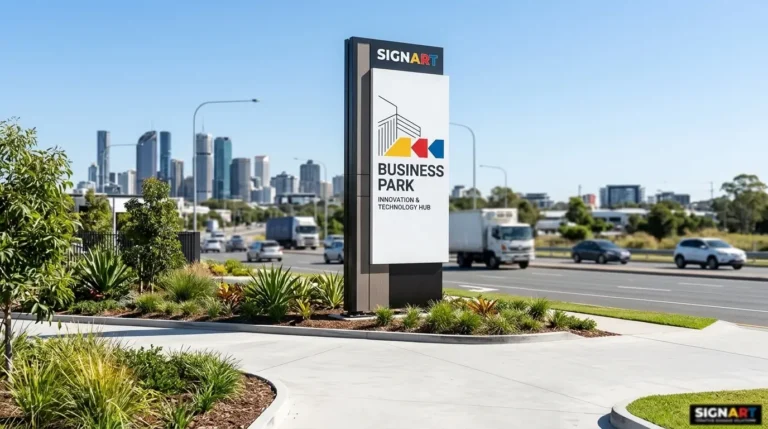
The second is size and position. A larger fascia sign, a sign that projects further than the limits allow, or a freestanding structure will usually need a proper assessment. When in doubt, treat the sign as needing approval until the Council tells you otherwise.
Brisbane Signage Approval for Shop Front Signs
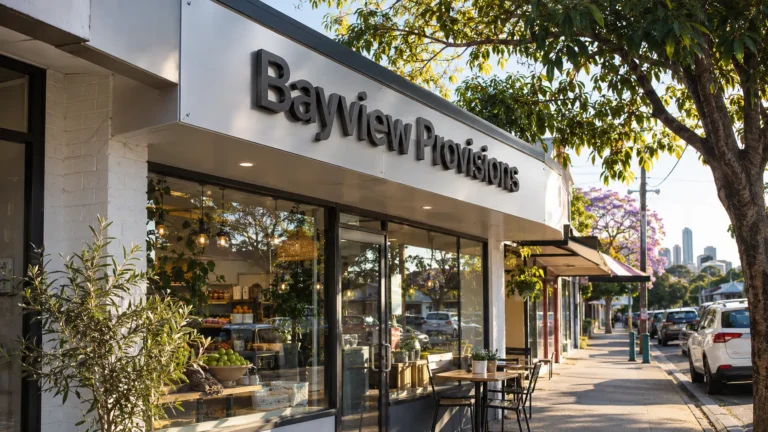
Shop fronts are where most Brisbane signage approval questions start. A typical shop front might carry a fascia sign, an awning sign, window graphics and a projecting or illuminated sign, all at once. Each element is judged against the rules for its own type.
Our own shop front signs page says that some shop front signs require a development approval from Brisbane City Council. Flat panel signs and simple lettering often sit at the easier end. Larger or more complex signs deserve an early check.
Illuminated and 3D signs add another layer. The Council asks for device design and construction details in an application, so you will want accurate drawings that show how the sign is built, lit and fixed. Brisbane’s strong sun and summer storms are good reasons to talk through materials and fixing methods before the design is final.
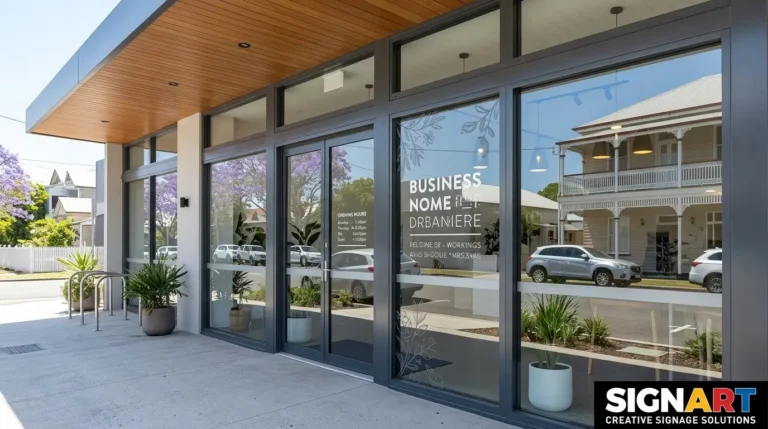
Window graphics also count as part of your signage. If you plan to add window graphics alongside a new fascia sign, mention them when you speak to the Council so nothing is missed.
A-Frame and Footpath Signs: Easy to Get Wrong
Footway signs, which most people call A-frames, are on the Council’s list of devices with size and placement limits. They sit on public space, so where you put them matters as much as how big they are.
Before ordering A-frame signs, measure the footpath outside your shop and check the Council’s current limits. A well-designed A-frame that ends up in the wrong place is still a problem.
Landlord Approval Is a Separate Step
Council approval and landlord approval are two different things. You can meet every Council rule and still be told no by the building owner, strata committee or shopping centre manager. Many commercial leases include their own signage clauses, so read yours before you design anything.
The two steps also connect. If you do not own the land, the Council’s application asks for a landowner’s consent form. Getting your landlord’s written agreement early saves weeks later. SignArt QLD helps businesses with landlord and council requirements as part of the signage process.
How to Apply: A Simple Step-by-Step Process
The Council runs the application online. Here is the order that tends to work best for a Brisbane business.
- Check your property. Find out whether it has a Heritage or Commercial character overlay, or sits in a mall area with special rules.
- Match your sign to the rules. Compare the type, size and position against the Permitted Advertising Devices Designation.
- Get your landlord’s consent. Ask for it in writing and keep a copy for the application.
- Prepare your documents. The Council asks for site plans, design or construction details, and a landowner’s consent form if you do not own the land.
- Consider a pre-lodgement meeting. The Council offers these to identify problems before you lodge. Fees apply.
- Lodge online. Use the Brisbane City Council advertising device approval page.
The Council says full assessments receive an initial response within 30 working days, and you can seek a review within 20 working days of a decision notice. Approved building work must be finished within one year, with one extension available. Fees and timeframes change, so confirm the current details on the Council’s page.
Planning Your Timeline and Budget
If your sign needs Brisbane signage approval, build the waiting time into your opening date. Thirty working days is about six weeks before you even receive an initial response, and that is before manufacturing and installation.
A sensible order of work is to confirm the rules, settle the design, get landlord consent, lodge the application and only then commit to production. SignArt QLD sends a design proof for your approval before production starts, which gives you a clear drawing to use in your application.
Common Mistakes to Avoid
- Ordering first and asking later. This is the most expensive mistake on the list.
- Assuming the old sign was approved. The sign left by the last tenant may not meet today’s rules.
- Ignoring overlays. A heritage or character overlay changes the answer completely.
- Forgetting the landlord. Council approval does not replace your lease obligations.
- Leaving out small signs. Flags, A-frames and window graphics all count.
How SignArt QLD Helps
SignArt QLD has an in-house design team, builds signs at its Brendale workshop and installs them with its own team. That means the person drawing your sign is working with the people who will build and fit it. We can advise on landlord and council requirements and help you prepare the details a Brisbane signage approval application needs.
Our office is open Monday to Friday, 7:30am to 4:30pm. You can call (07) 3881 1185 or send a message through our contact page.
Check First, Then Build
The cheapest sign is the one you only have to make once. Spend an hour checking your property, your sign type and your lease, and you will know whether you are in self-assessable territory or heading for an application. Then you can brief a signmaker with confidence.
If you are planning a new sign and are not sure where you stand on Brisbane signage approval, talk to us early. Contact SignArt QLD with your address and a sketch or idea, and we will help you work out the next step.